THE BOWIE KNIFE THAT KILLED DRACULA


“Bram Stoker’s Dracula was killed by a bowie knife?  And by a Texan?  No way!  It was done by a stake in his heart –  right?”

” Wrong!”

In Bram Stoker’s Dracula, first published in 1897, he is indeed killed by a Texan welding a bowie knife.  Obviously, I had not read the book even though I have a copy of it along with Mary Shelly’s Frankenstein that I did read recently.

I subscribe to print and digital versions of Texas Monthly, a magazine that covers all things Texas – politics, art, dance halls, food, music, tourist spots, trends, rodeos, history, tequila,  glamour and grit.  The magazine upholds the pride of a currently red state with a weird blue capitol of Austin without being pompous while poking fun of a state that was once a country and has threatened to secede in recent years.

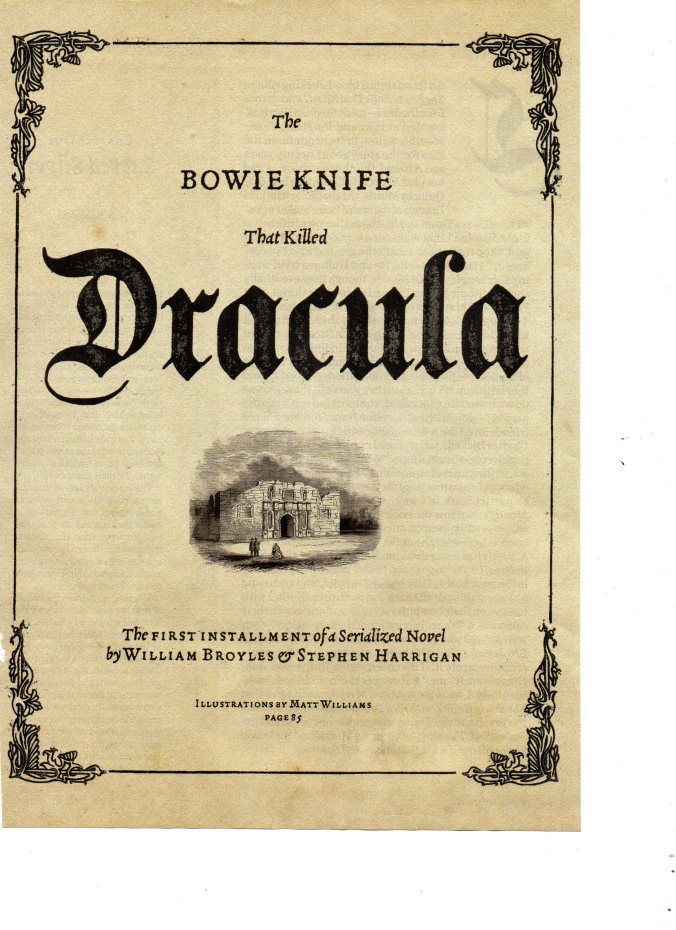
In the October 2025 issue the first installment of The Bowie Knife That Killed Dracula, a novel by William Broyles and Stephen Harrigan, was published.  It is described this way.

“The character who kills Dracula at the end of Bram Stoker’s classic novel is Quincey Morris, a Texan who does the job with a bowie knife.  Our serialized novel tells his story – and that of his famous  blade.”

I anticipate each new chapter that comes out every Saturday and I have started reading Bram Stoker’s novel.  It is rather like reading parallel novels.  Here is a link to the first installment.

Now Texans have something else to brag about!  And the bowie knife has a worthy history of its own.


Gulf of MEXICO


On inauguration day President Trump, with a flourish and a smile, signed one of many executive orders. The White House touted the order as “Restoring Names That Honor America’s Greatness.”  This one combined name changes for the largest gulf in the world  and the highest peak in the United  States.   Mount Dnali was once again Mount McKinley  to honor President William  McKinley.  The Gulf of Mexico was henceforth to be called Gulf of America to honor America’s greatness.  All government references were to comply; Google and others soon would reflect both new names. These changes will not solve any world problems, but it apparently made the President happy to be able to do so.

Granted, President Obama in 2015 pleased Native American Indians by renaming Mount McKinley to honor Native Americans Indians who had  traditionally referred to it as Dnali.  The state of Alaska had  requested the United States government for the name change in 1975 but was denied.

And what about that body of water known for five hundred years as the Gulf of Mexico and shared by the US, Mexico and Cuba who all claim some territorial rights?  As a coastal crone I live on the Texas Gulf Coast on Nueces Bay and a few miles from the Gulf of Mexico.

Texas shares the Gulf with three other states and the countries of Mexico and Cuba.  It provides rich marine life, tourism. off shore drilling. and more.  During WWII German U-boats were sunk in its waters.  We worry when there is an oil spill or leak.  All eyes are on The Gulf during hurricane season.  We worry about pollution along our coastlines.  We share a long and rich history including battles, disputes and pirates.  The Republic of Texas had its own navy for a time.

The Associated Press (AP) continued to refer to it as the Gulf of Mexico and as a result has been denied access to some presidential events in the White House and Air Force One.  The AP has been the standard for style for years.  A lawsuit to end the ban is pending.

It seems we are beginning to be governed by daily executive orders.  For now most of us will probably continue to just call it “The Gulf,” but everyone knows we mean the Gulf of Mexico!

FRIDAY PHOTO: NORTH BEACH 1936


This is a photo of my mother and my two older sisters taken on the sands of North Beach in the summer of 1936. North Beach is a part of the city of Corpus Christi. Access to it then meant crossing the ship channel via a draw bridge. It would have been an eighty-mile drive for my parents from the small town of Freer eighty miles west.

There was a permanent carnival that went almost to the water’s edge with many attractions and rides like a Ferris wheel, Tilt-a-Whirl, bumper cars and the merry-go-round my mother and sisters were posed in front of. The midway offered cotton candy and candied apples and the usual games hawked by carnival barkers. The sound of the waves competed with the sounds of the carnival. Going back there years later as a child with my parents in the 1950s, I thought it was a magical place infused with the scent of the sea. Maybe I still do.

The carnival is gone now and the attractions are different. The USS Lexington Museum, a WWII aircraft carrier. is docked not far from where this photo was taken. Further down the beach near the ship channel is the Texas State Aquarium.

I live about ten miles from North Beach.

LUNCH AT LA CUEVA


Portland, Texas is not funky, cool or artsy like Port Aransas or even Rockport; it used to be a quiet bedroom community to Corpus Christi where many of us commuted ten miles to work there. Community life revolved around schools, sports and churches. The few small restaurants could not sell alcoholic drinks, and if you wanted to buy liquor, you had to make a run to Jessie’s Liquor in Gregory, a tiny town five miles away. There was no public art.

Today industries,some international, have taken advantage of our location on the Gulf of Mexico and our connections to the Port of Corpus Christi. Industries brought jobs and growth. Chain restaurants have opened and one can enjoy an alcoholic drink with dinner and purchase liquor at one of three liquor stores. With good schools it is still a good place to raise a family. There is still no public art other than a memorial tribute to the military and veterans at city hall.

When an art gallery that serves lunch opened up recently, I persuaded Husband to check it out with me. I keep telling him we need more art in Portland.

La Cueva (the cave in Spanish) is owned and run by Gilbert Cuevas, who is also the artist in residence. He moved to Portland from San Antonio after a successful career in graphic advertising. Growing up in the west side in the barrios, he painted what he saw around him.

The ambiance of La Cueva is unexpected for Portland: intimate dining area, dark wood, tall columns, small bar, sophisticated, elegant yet relaxed and casually classy. His paintings – for sale – are displayed gallery style. A curved staircase leads to more art upstairs. The facility is available for private events. The menu offered salads and sandwiches; wine was available. We had The Cubano – deliciosa!

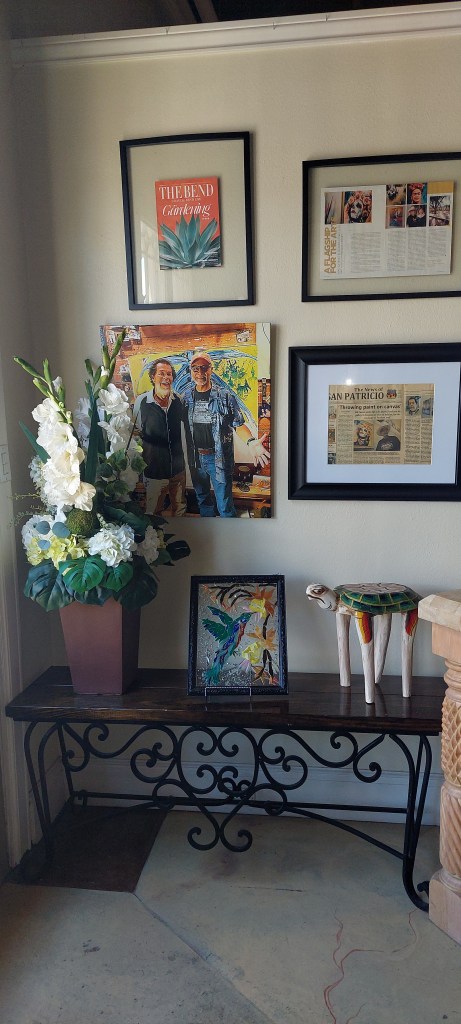
For a look at some of the art of Gilbert Cuevas and his art, go to La Cueva Art Gallary.

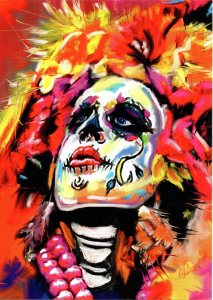
Reproductions of some of his original art was available in postcard form. Here is one of several I purchased to share.

TEXAS INDEPENDENCE DAY 2021


Texas Independence Day is the celebration of the adoption of the Texas Declaration of Independence on March 2, 1836. With this document signed by delegates, settlers in Mexican Texas officially declared independence from Mexico and created the Republic of Texas.  It remained a Republic until1845.

On March 2, 2021 Governor Greg Abbot declared another type of independence for Texans by lifting the state-wide mandatory mask requirement and opening all businesses to 100% capacity.  It will be up to businesses whether to require masks for customers and employees; the governor urged “personal vigilance” as he pointed to the arrival of vaccines and good Texas economy as reasons for his decision.  He tightened control over Covid restrictions by mandating that county judges could only implement restrictions if hospitalizations rose above 15% of the capacity for any of Texas’ 22 hospital regions.

Texans should have been dancing in the streets, right?   Yes, bars and restaurants welcomed the news that they could open to full capacity.  Yes, and those who did not believe in masks in the first place and  considered the restrictions an assault on their freedom by the government were rejoicing.  Enter the divide.

Abbot was soon criticized by those in the medical field, government leaders and even the CDC for opening the state too soon.   Citizens took side on the issue. Some businesses began announcing that they would still require masks for employees and customers; others will not require them. This goes into effect Wednesday.

Personally, I am ready to get back to something like normal, but I think he should have waited until more Texans were vaccinated,  COVID numbers were better and we were closer to herd immunity.   Husband and I have had our second shots so we feel we have some protection, but we will not have a problem continuing to wearing  a mask when required.   Will it be the right decision or will cases, hospitalizations and deaths spike?  Will vaccinations make a difference?

April 21 is San Jacinto Day in Texas, the day the Texan Army led by General Sam Houston defeated the Mexico Army near present-day Houston in 1836.  We will see where we are  by then and  if Governor Abbot can claim a victory for all Texans or if he will he face defeat like General Santa Anna, the general who led the Mexican army.

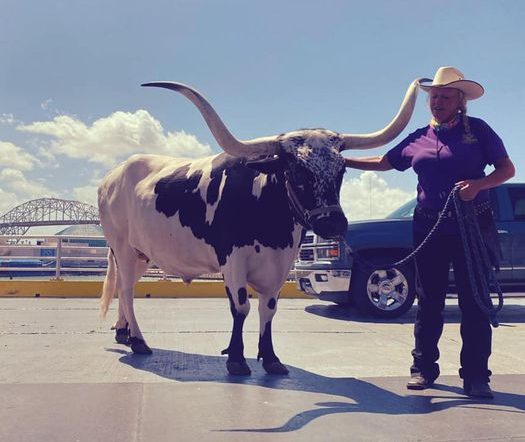
FRIDAY FOTO: LONGHORN ON THE LEX


Photo borrowed from the Facebook page of the USS Lexington Museum on the Bay

Tex, the Longhorn steer, recently visited the USS Lexington on Corpus Christi Bay for a first-ever fundraiser for the WWII aircraft carrier.  It was a show streamed live on the ship’s Facebook page from the flight deck and featured Brian Black and his band.  Yes, he is related to Clint Black (brother) and plays country music.  Tex was available for photos as he was saddled up, literally, for a good cause.  This historic ship was closed for two months because of COVID-19 but it is now open for visitors.

In December the Lexington will host another fundraiser on the flight deck.  This time it will be put on by the Professional Bull Riders (PBR) and will benefit charities that support the military and their families.  The event will be  professional bull riding right on the flight deck. Yes, real bull riding by real cowboys.  Only in Texas!

Link to the Lexington website is here.


CAMELS ON THE COAST


The Texas coast town of Indianola  was once a major port and the county seat of Lavaca County.  Incorporated in 1853, it was a port of entry for many German immigrants and at its height had a population of 5,000.  In 1875 a hurricane destroyed the town and killed several hundred people; those remaining rebuilt.   Just over ten years later in 1886 another destructive storm struck the recovering town.  This time the residents did not rebuild but scattered as the county seat was moved to nearby Port Lavaca.

Today if you visit the area you will not find much of this ghost town left other than a stone marker for the courthouse and a Texas Historical Marker for the town of Indianola.  And there is a rather strange rustic metal sculpture of a man leading a camel.

This photo came from the Calhoun County Historical Commission website.

A few feet in front is a state marker with this title and explanation:
THE GREAT CAMEL EXPERIMENT

No immigrants arriving in Indianola were quite as exotic as the seventy-five camels that came ashore in 1856 and 1857 from Algeria, Tunisia, Egypt and Turkey. As early as 1836, politicians, diplomats and the military were considering the importation of camels for use in North America’s desert wastelands. In 1853, secretary of war Jefferson Davis, a man familiar with harsh desert conditions, proposed to congress the use of camels as pack animals in the desert southwest. Congress approved the request on March 3, 1855. After a three-month voyage from the Mediterranean, the Fashion entered Matagorda Bay on May 13, 1856 and landed the camels at the wharf at powder horn. Thirty-four camels, ranging from Bactrians (two-humped variety), Arabians (one-hump variety) and a hybrid-cross between the two, came ashore. Many residents of Indianola recalled the unusual sight of the camels being led through the streets. By February 1857, a second government shipment of forty-one camels arrived in Indianola. Military camel caravans carrying supplies became more common in the Texas Hill Country between the camels’ home of Camp Verde and San Antonio. The camels, along with traditional livestock, were used in the summer of 1857 to survey the great wagon road between Arizona and California, now known as Route 66. The camels were also used in 1859 and 1860 for reconnaissance in west Texas, surveying routes to the U.S./Mexico border. In 1861, upon the outbreak of the Civil War, all U.S. military assets, including the camels, came into possession of confederate troops and, after the war, the camels were auctioned off. (2013) Marker is Property of the State of Texas”

There is not much left of the old Camp Verde  facility, located between the towns of Kerrville and Bandara in the Texas Hill Country, except for a stone marker.  About a mile away is the site of a store on Verde Creek established in 1857, mainly to supply the fort.

The original store was was washed away by the creek.  Today it is the site of Camp Verde General Store and Restaurant, a rustic Hill Country attraction.  Outside is a rather abstract metal camel sculpture as a nod to its past.   Husband and I would like to visit both sites in the fall.

Photo taken from Camp Verde General Store and Restaurant website


TEXAS NAVY 1836-1846


Texas was a republic for almost ten years before it joined the United States in 1845 as the 28nd state and a slave state.  As a new republic fighting Santa Anna as he advanced into Texas, a  Texas Navy was established to protect the coastline by keeping the lines of supply from New Orleans open and keep Mexican ships from delivering supplies to Santa Anna.  Those first four schooners, Invincible, Brutus, Liberty and Independence played an important part in the victory at San Jacinto but the navy’s role is not as well known as most of the glory went to the victories on land.

In March of this year a permanent exhibit honoring the Texas Navy opened on the USS Lexington Museum, a WW II aircraft carrier berthed at Corpus Christi. The ship serves as a naval aviation museum,  education facility and tourist attraction.   Recently I visited  after having lunch with Daughter who works on the Lexington.   The ship has five self-guided tours and offers guided tours for behind the scenes.  The Texas Navy exhibit is on the ” Lower Decks Tour”, tour number four.
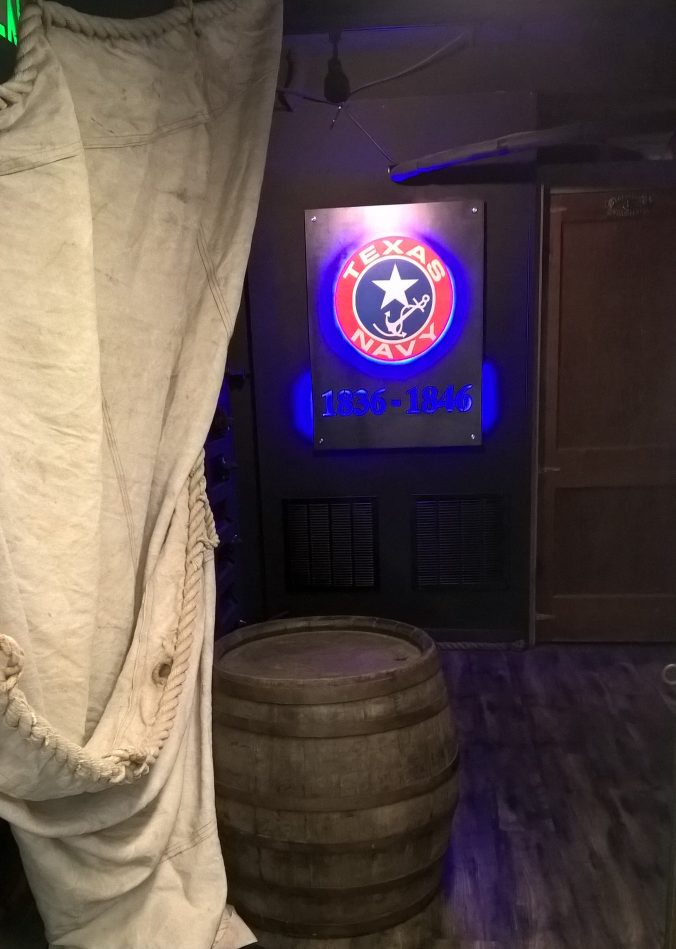
NEON ENTRANCE TO EXHIBIT

Visitors are immediately drawn into the 1800s and a different kind of warfare and away from the WWII period.

WORKING SAILORS

These sailors seem to be welcoming you aboard; even the worn wooden flooring feels like the deck of a ship and much different from the metal and steel floors of a WWII ship.
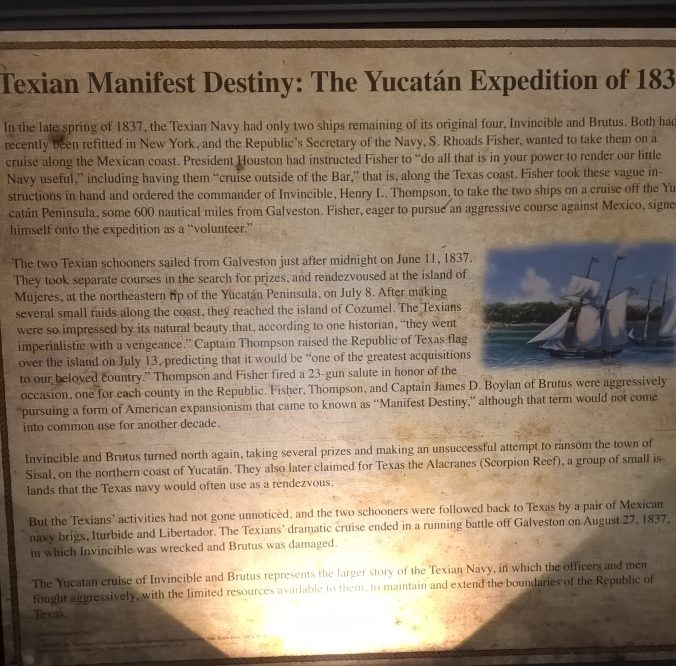
Photos of these two story boards did not come out very well – Husband could have done better had he been along – but they do give information on the importance of the Texas Navy early on and later as it continued to protect the new republic.

BATTLE OF CAMPECHE 1843
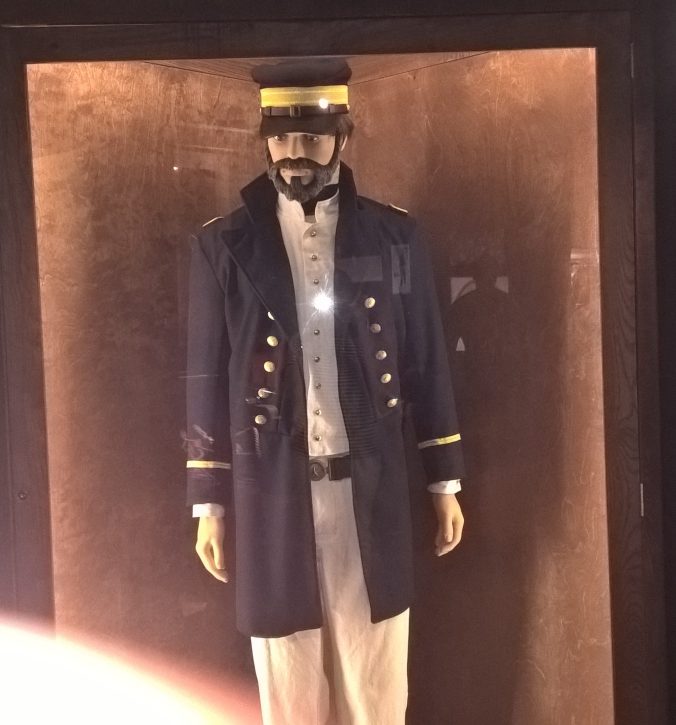
NAVAL OFFICER

I don’t know what the white object is on the left.  Perhaps it was one of the rumored ghosts on the Lexington.  It was a weekday afternoon and not very crowded, so I often found myself alone to leisurely view the Texas exhibit and  WWII photos and documents also as I competed the Lower Decks Tour.  OK, it was probably  my finger that got in the way!

SHIP’S WHEEL

Take a turn at the ship’s wheel!

CANNONS AIMED AT MEXICAN SHIPS

Visitors can get the feel of being on a ship in the heat of battle with this replica of a warship; note the Mexican flag on the ship being fired upon.

NAVAL GEAR AND ARTIFACTS

There were several displays like this one.
TEXAS NAVY FLAG

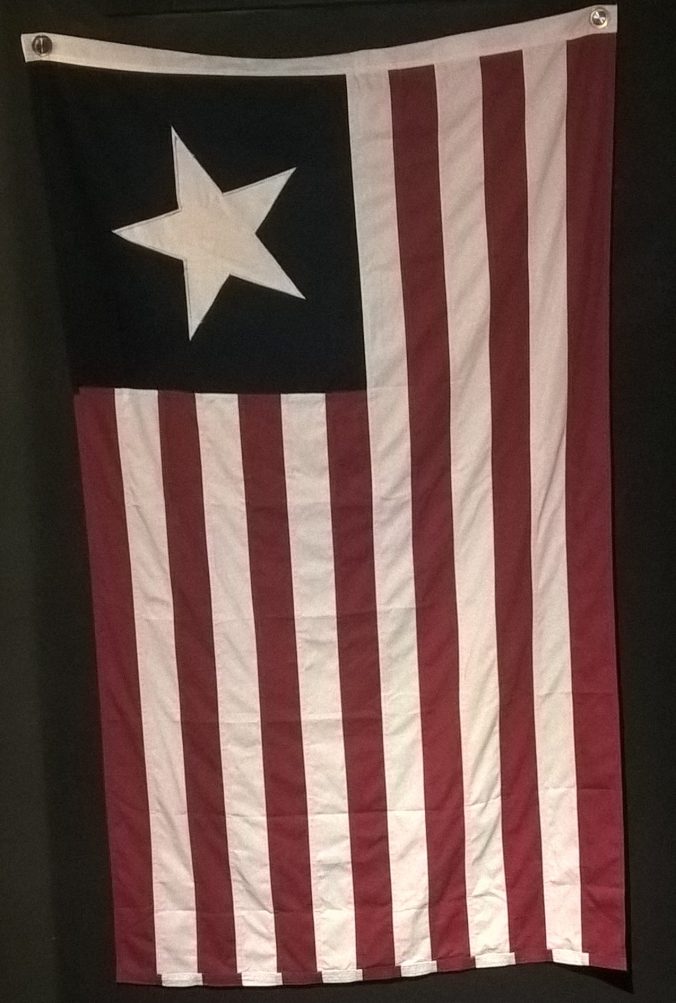
This is the Texas Naval flag.  Texas Flag Park describes it this way:

Created by Charles Hawkins for the Texas Navy in April, 1836 the Lone Star and Stripes Flag was adopted and continued unchanged for the life of the Republic. It carried a single white star in the blue canton, and seven red stripes and six white stripes alternating in color. The stripes represented the original thirteen colonies of the U.S. The flag was deliberately designed to resemble the national flag of the U.S. When the flag hung limp, it could be mistaken for the American flag which gave the underdog Texan fleet the advantage of surprise, and it worked.

There is a small theater inside the exhibit, though I did not take a photo, with an excellent documentary,  How the Texas Navy Saved the Revolution, a Kahunas USA / Texas Navy Association historic documentary.  The film is available to all Texas teachers for free download at texasnavy.org under the “Teachers” button.

When Texas joined the Union the proud Texas Navy was absorbed into the United States Navy.  “Texas Navy 1836-1846” is an excellent addition to the WWII exhibits on the Lexington for anyone who is interested in Texas history.


LOST PORTRAIT OF MY FATHER


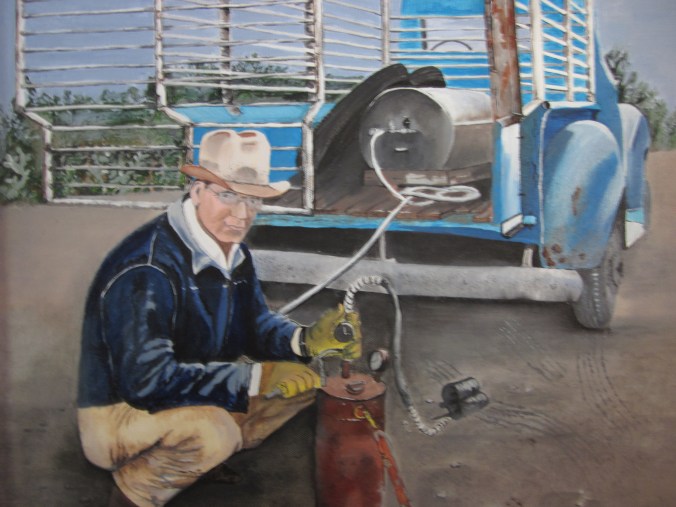
ACRYLIC ON CANVAS BY CHERYL LYLES SMITH

Some of you may remember my writing about the loss of my sister’s and brother-in-law’s home by fire the morning before Hurricane Harvey hit.  My brother-in-law had called me to invite us out to stay with them if we did not want to ride out the storm here on the coast.  They lived eighty miles west of here on the family ranch and in the house that I grew up in.

The above portrait of my father was painted by their daughter (my niece) who died of cancer at age 57 in 2012.  The  painting was done from a small photo of him in exactly the same pose taken probably in the late 1950s.  It hung in the entrance to her parents’ home.  A few years ago when we were visiting I had Husband take a photo of it because it was very special to me.  Now I am so grateful that he did as the painting was destroyed in the fire along with everything in the house.  Perhaps I should explain the painting for those of you not familiar with the practice of burning prickly pear cactus.

In the painting my father is filling up his pear burner with butane from the tank in the pick-up.  He would then strap it across his shoulder and go out into the pasture where there was plenty of prickly pear cactus.  As he turned it on fire would come out of the end of it and he would burn or singe the thorns off the cactus.  With the large thorns gone the cattle would eagerly eat the cactus as a good source of protein and contained water.  During times of drought when there might be little for the cattle to eat and feeding hay might be too expensive for a rancher, this method would help to get through the lean times.  Burning pear was most common in the fall and winter, but I have seen my father burn pear into the spring and fall if it was a really dry year.

Today times have changed and few people burn prickly pear.  The pear burner was invented in 1914 by John Bunyan Blackwell.  A photo of one can be seen at the Bullock Museum website.

As a footnote, my sister and brother-in-law built a new house on the same spot as the one that burned and were able to move in just before Christmas.  Husband and I went out Christmas Eve to see it and to celebrate their 70th wedding anniversary.  I had prints made from the photo Husband took as gifts for family members.  Life goes on.

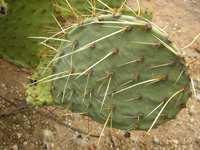
       Here is a close-up of prickly pear cactus so you can see the sharp thorns.


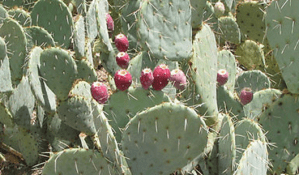
Here is a cluster of them together with the red fruit or tuna.