MINCEMEAT PIE, CIGARS AND CIGARETTES


The officers and crew on the USS Lexington celebrated Thanksgiving 1945 somewhere in the Pacific after months of fighting; but WWII was finally over and they had much to be thankful for.

MENU COURTESY OF THE LEXINGTON’S HISTORIAN, MELANIE TEMPLIN

Along with the usual turkey, dressing and cranberries to remind them of home, sailors were offered mincemeat pie, cigars and cigarettes.

Today I doubt that cigars and cigarettes would be listed on the menu and there might not be mincemeat pie for dessert.  Mincemeat pie seems to have fallen out of favor as a Thanksgiving and Christmas tradition.

Today’s mincemeat (mainly raisins, apples and spices) does not contain meat.  In Victorian times it sometimes  would.  Mincemeat comes in a jar or condensed in a box and can be made into a variety of desserts:  cookies, pies, fruitcake, etc.  One of the oldest brands is None Such Mincemeat and is the one I use to make pies and cookies at Christmas.

For the past few years I have had trouble finding it in local grocery stores, especially the condensed in a box that I use for cookies.  This year I could only find it in jars and had to drive to Corpus Christi for it; I bought two jars even though the price has almost doubled from last year.  It is even higher on Amazon.  The None Such website promises to have condensed by the 2025 holiday season – we will see!  For the first time None Such Mincemeat is available online with a limit of two per order.  The link is shared here for those who may be fans of the old-fashioned.

Growing up, I remember that for Christmas we always had fruitcake and mincemeat pie.  I have already made a mincemeat pie and fruitcake.   Cheers and Happy Holidays!

JAPANESE GOOD LUCK FLAG CEREMONIAL REUNION IN TOKYO


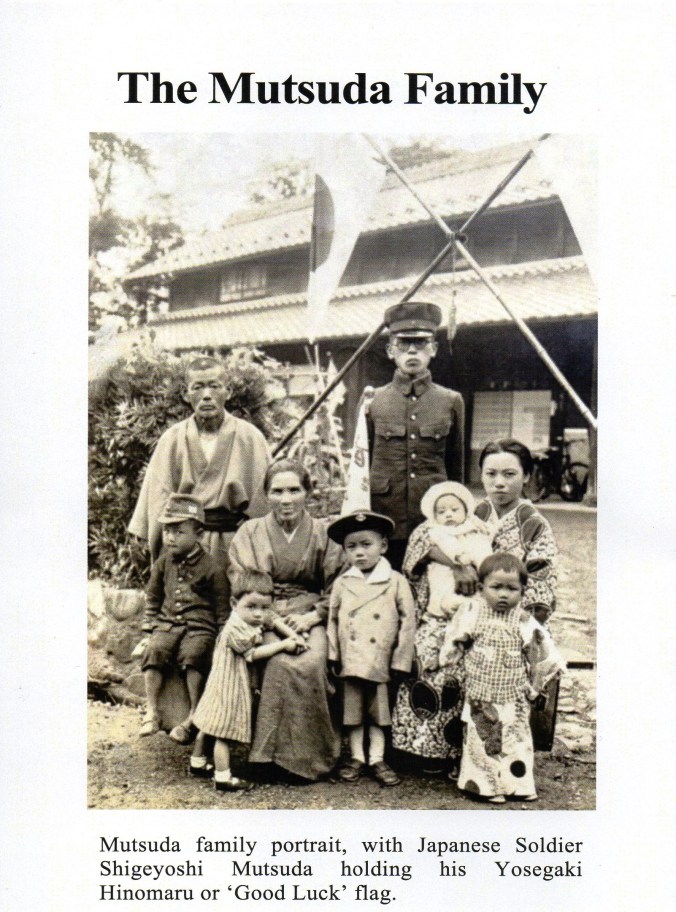
     Representatives from the USS Lexington Museum were in Tokyo, Japan recently, to reconnect a family after 80 years of separation, with the return of the Yosegaki Hinomaru or “Good Luck Flag”, that belonged to World War II Japanese soldier Shigeyoshi Mutsuda .  The ceremony took  place at a national shrine in Tokyo July 29th.  The children of Mr.Mutsuda received the flag, viewed as his spirit returning home, that can reunite with his wife who recently passed away at the age of 102.

Steve Banta, Executive Directer of the USS Lexington Museum (left); Toshihiro Mutsuda (right) son of Shigeyoshi Mutsuda (Photo Shuji Kajiyama/AP)

     The flag being returned was donated to the USS Lexington Museum in 1994.   It was only recently identified as a “Good Luck” flag; signed by family and friends of Japanese service members prior to leaving home for war. For Japanese families, the Good Luck Flags are often all that remains of their loved ones killed in action, and the return of the flag is seen as the return of their family member’s remains.

“Like many women of her time, Mrs. Mutsuda’s husband made the ultimate sacrifice for his country, which left her to provide for all of their family’s needs. The feeling of loss of her soulmate was very difficult, and only eased on rare occasions when she could make the long journey to the national shrine to commune with her husband’s spirit.
This shrine is where the ceremonial reuniting took place, with husband and wife finally finding peace, together.” (From USS Lexington Museum site)
Here is a link to my post about the Reparation Ceremony held July 20, 2023 on the USS Lexington Museum in Corpus Christi, Texas:  https://coastalcrone.com/2023/08/09/japanese-good-luck-flag-reparation/


JAPANESE GOOD LUCK FLAG REPARATION


THE JAPANESE GOOD LUCK FLAG

A special ceremony was held July 20,2023 at the USS Lexington Museum; below is a portion of the program.

“A flag donated to the USS Lexington Museum in 1994 was recently identified as belonging to a Japanese soldier named Shigeyoshi Mutsuda, killed in action during World War II.  Known as Yosegakki Hinomaru, or Good Luck Flags, these types of flags were signed by family and friends of Japanese service members prior to leaving home for war.  For Japanese families, the Good Luck Flags are often all that remains of their loved ones killed in action, and the return of the flag is seen as the return of their family member’s remains.

USS Lexington Museum is working in partnership with the OBON SOCIETY to repatriate the flag back to Japan for the flag to be reunited with the soldier’s surviving family members.  OBON SOCIETY is a non-profit organization that over the past 13 years has repatriated more than 500 flags back to Japanese families and communities.  The organization’s founders, Rex and Keiko Ziak, will act as representatives of the family to accept the flag and bring their long-lost patriarch home, including a ceremonial reuniting with his wife who recently passed at the age of 102.  Representatives from the USS Lexington Museum will accompany OBON SOCIETY to escort the flag on its journey back to Japan and the family.”

MELANIE TEMPLIN, left, Historian/Registrar; RACHELLE BANDA, right, Special Events Coordinator

As part of the ceremony, the flag (encased in a frame) was taken down from its place in an exhibit and presented to the representatives of the Japanese family.  Our daughter, on the left, is the Historian/Registrar for the USS Lexington Museum; the woman on the right is also an employee.  Those in the back in yellow shirts are volunteers for the museum; many are veterans.  The Japanese soldiers would have been able to fold the flag very small and keep it near their heart underneath their uniforms as they went into battle.

As the flag was removed from the exhibit and brought down for presentation,  a Japanese song about love and loss was played.  It became popular first in Japan and then hit the top of the charts in 1963 in the United States.  I remember it well

Below is a link to the ceremony held in the hanger bay of the museum.  It is about an hour long but is well done and symbolizes the friendship  and strong ties between the two countries today. The flag was returned to members of the Mutsuda family in Japan a week later.  I will have a post about that soon.  War brings loss and pain for the families on both sides.


FRIDAY PHOTO: NORTH BEACH 1936


This is a photo of my mother and my two older sisters taken on the sands of North Beach in the summer of 1936. North Beach is a part of the city of Corpus Christi. Access to it then meant crossing the ship channel via a draw bridge. It would have been an eighty-mile drive for my parents from the small town of Freer eighty miles west.

There was a permanent carnival that went almost to the water’s edge with many attractions and rides like a Ferris wheel, Tilt-a-Whirl, bumper cars and the merry-go-round my mother and sisters were posed in front of. The midway offered cotton candy and candied apples and the usual games hawked by carnival barkers. The sound of the waves competed with the sounds of the carnival. Going back there years later as a child with my parents in the 1950s, I thought it was a magical place infused with the scent of the sea. Maybe I still do.

The carnival is gone now and the attractions are different. The USS Lexington Museum, a WWII aircraft carrier. is docked not far from where this photo was taken. Further down the beach near the ship channel is the Texas State Aquarium.

I live about ten miles from North Beach.

The Shared Fate of the Robert E. Lee and the German U-166


German submarines posed a threat not only to ships crossing the Atlantic, but also to ships in the Gulf of Mexico. Between 1942 and 1943 approximately 70 ships in the Gulf of Mexico and off the coast of Texas were sunk by the German U-boats as they roamed the Gulf.

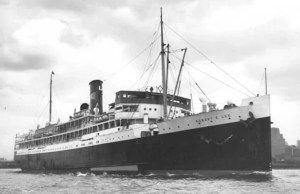
The passenger-freighter Robert E Lee had left Trinidad and was headed to Tampa when it was diverted to New Orleans. On board were passengers it had picked up from two other ships who were hit by torpedoes and was heading to New Orleans with an escort, USS PC-566.

The Robert E. Lee

On July 30, 1942 the Robert E Lee was hit by a torpedo fired by a German submarine or U-boat. The ship began to list and sank within fifteen minutes beneath the waters of the Gulf of Mexico about fifty miles from the mouth of the Mississippi River. Most of the of the passengers and crew were able to escape in life boats or with life jackets. One officer, 9 crewmen and 15 passengers of were lost. (total of 283 passengers were on board.)

The escort ship, USS PC-566 fired depth charges in the area where signs of it had last been seen. Soon after an oil slick appeared; it was assumed that the U-boat had been hit and destroyed. It and other boats in the area aided in the rescue of passengers and crew.

German U-166

In July of 2014, nearly 72 years later, stunning photos of the two wrecked vessels were released. The scientific ship, Exploration Vessel Nautilus had been checking for damage from the BP oil spill in 2010 when the scientists aboard came upon the wrecks only a two miles apart. Two remote operated submersible vehicles equipped with cameras captured clear images of both sites. Designated as war graves the casualties from World War II, they will not be disturbed.

Below is an excellent link put out by the scientific organization that took the photos. The images of the Robert E. Lee and U-166 are haunting.

A Tale of Two Wrecks: U-166 and SS Robert E. Lee

Thanks to blogger Brad Purinton for the inspiration for this post.  In a comment he left on my “Sand Pounders” post, he mentioned this incident. His father who was a child living in New Orleans at the time and remembered stories of German submarines near the mouth of the Mississippi His blog, Tokens of Companionship, features portrait photos from 1839 to 1939. Check it out here.

SAND POUNDERS


Sand pounders? What are they?  Tools for creating a sand sculpture? Some new social media? I had come across the phrase while doing some research for something I was writing that involved World War II.

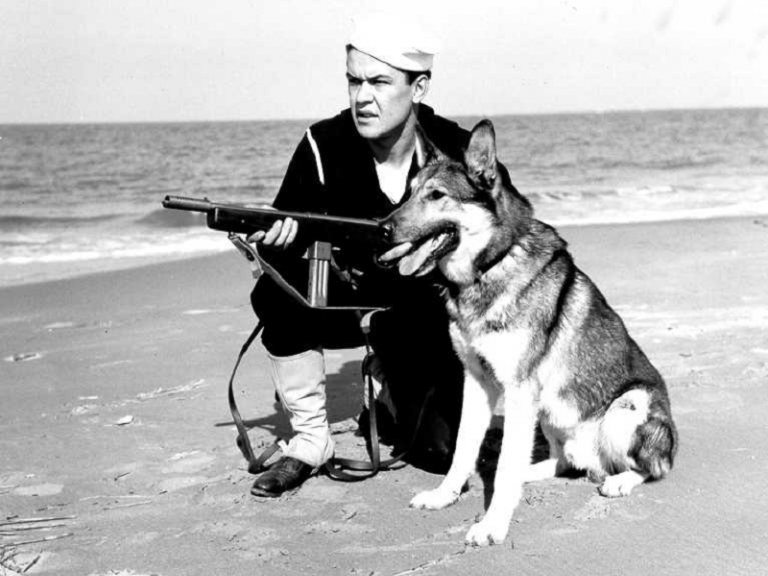
The Coast Guard Beach Patrol, eventually known as Sand Pounders, began in June 1942 in response to the threat of a German coastal invasion. The three main purposes were to “detect, observe and report offshore enemy vessels; to report enemy landing attempts; and to prevent people on land from communicating with the enemy at sea.” The threat of a coastal invasion by Germany was real to American citizens. German U-boats were a threat to ships crossing the Atlantic and were detected off the Eastern Coast and in the Gulf of Mexico. There was also the fear of invasion on the West Coast by the Japanese.

Coast guards would often be mounted on horses or on foot and were armed with radios and weapons. Those on horseback could cover ground more quickly and efficiently and usually work in pairs. Those on foot were often accompanied by dogs who could aid in detecting and protecting. German Shepherds, Doberman Pinschers and Airedales were used, with the German Shepherd the preferred breed.

At its height, the Beach Patrol consisted of around 24,000 men who protected 2,700 miles of coastline from potential enemy invasion; the patrols ended in 1944 when preparations for the Normandy invasion began. While the Coast Guard is not often given as much mention in World War II as perhaps the other military branches, the Beach Patrol played a vital part in protecting the United States coast from enemy attack.

CAMELS ON THE COAST


The Texas coast town of Indianola  was once a major port and the county seat of Lavaca County.  Incorporated in 1853, it was a port of entry for many German immigrants and at its height had a population of 5,000.  In 1875 a hurricane destroyed the town and killed several hundred people; those remaining rebuilt.   Just over ten years later in 1886 another destructive storm struck the recovering town.  This time the residents did not rebuild but scattered as the county seat was moved to nearby Port Lavaca.

Today if you visit the area you will not find much of this ghost town left other than a stone marker for the courthouse and a Texas Historical Marker for the town of Indianola.  And there is a rather strange rustic metal sculpture of a man leading a camel.

This photo came from the Calhoun County Historical Commission website.

A few feet in front is a state marker with this title and explanation:
THE GREAT CAMEL EXPERIMENT

No immigrants arriving in Indianola were quite as exotic as the seventy-five camels that came ashore in 1856 and 1857 from Algeria, Tunisia, Egypt and Turkey. As early as 1836, politicians, diplomats and the military were considering the importation of camels for use in North America’s desert wastelands. In 1853, secretary of war Jefferson Davis, a man familiar with harsh desert conditions, proposed to congress the use of camels as pack animals in the desert southwest. Congress approved the request on March 3, 1855. After a three-month voyage from the Mediterranean, the Fashion entered Matagorda Bay on May 13, 1856 and landed the camels at the wharf at powder horn. Thirty-four camels, ranging from Bactrians (two-humped variety), Arabians (one-hump variety) and a hybrid-cross between the two, came ashore. Many residents of Indianola recalled the unusual sight of the camels being led through the streets. By February 1857, a second government shipment of forty-one camels arrived in Indianola. Military camel caravans carrying supplies became more common in the Texas Hill Country between the camels’ home of Camp Verde and San Antonio. The camels, along with traditional livestock, were used in the summer of 1857 to survey the great wagon road between Arizona and California, now known as Route 66. The camels were also used in 1859 and 1860 for reconnaissance in west Texas, surveying routes to the U.S./Mexico border. In 1861, upon the outbreak of the Civil War, all U.S. military assets, including the camels, came into possession of confederate troops and, after the war, the camels were auctioned off. (2013) Marker is Property of the State of Texas”

There is not much left of the old Camp Verde  facility, located between the towns of Kerrville and Bandara in the Texas Hill Country, except for a stone marker.  About a mile away is the site of a store on Verde Creek established in 1857, mainly to supply the fort.

The original store was was washed away by the creek.  Today it is the site of Camp Verde General Store and Restaurant, a rustic Hill Country attraction.  Outside is a rather abstract metal camel sculpture as a nod to its past.   Husband and I would like to visit both sites in the fall.

Photo taken from Camp Verde General Store and Restaurant website


TEXAS NAVY 1836-1846


Texas was a republic for almost ten years before it joined the United States in 1845 as the 28nd state and a slave state.  As a new republic fighting Santa Anna as he advanced into Texas, a  Texas Navy was established to protect the coastline by keeping the lines of supply from New Orleans open and keep Mexican ships from delivering supplies to Santa Anna.  Those first four schooners, Invincible, Brutus, Liberty and Independence played an important part in the victory at San Jacinto but the navy’s role is not as well known as most of the glory went to the victories on land.

In March of this year a permanent exhibit honoring the Texas Navy opened on the USS Lexington Museum, a WW II aircraft carrier berthed at Corpus Christi. The ship serves as a naval aviation museum,  education facility and tourist attraction.   Recently I visited  after having lunch with Daughter who works on the Lexington.   The ship has five self-guided tours and offers guided tours for behind the scenes.  The Texas Navy exhibit is on the ” Lower Decks Tour”, tour number four.
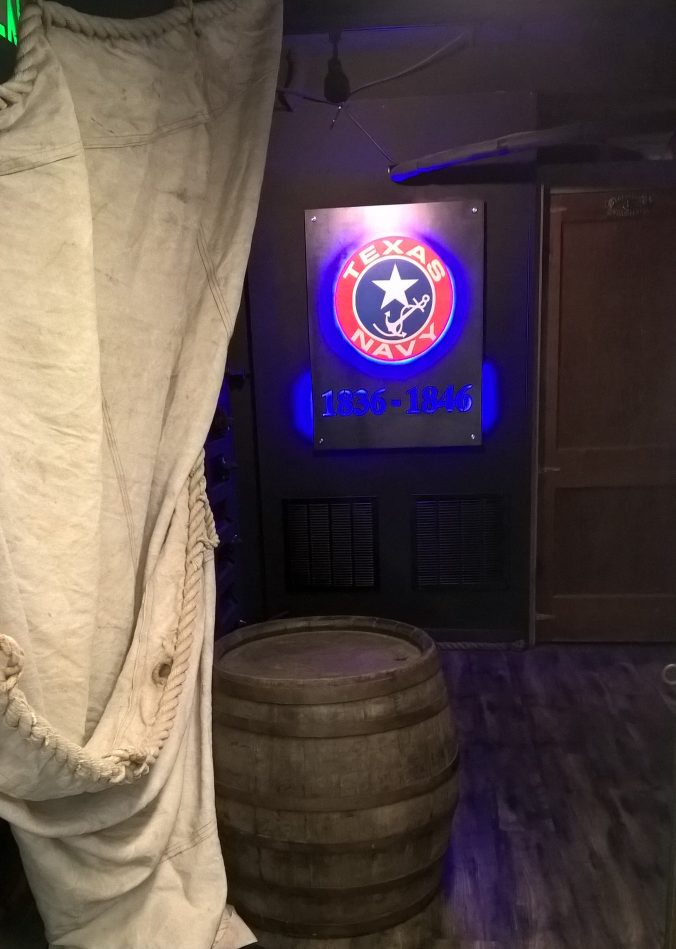
NEON ENTRANCE TO EXHIBIT

Visitors are immediately drawn into the 1800s and a different kind of warfare and away from the WWII period.

WORKING SAILORS

These sailors seem to be welcoming you aboard; even the worn wooden flooring feels like the deck of a ship and much different from the metal and steel floors of a WWII ship.
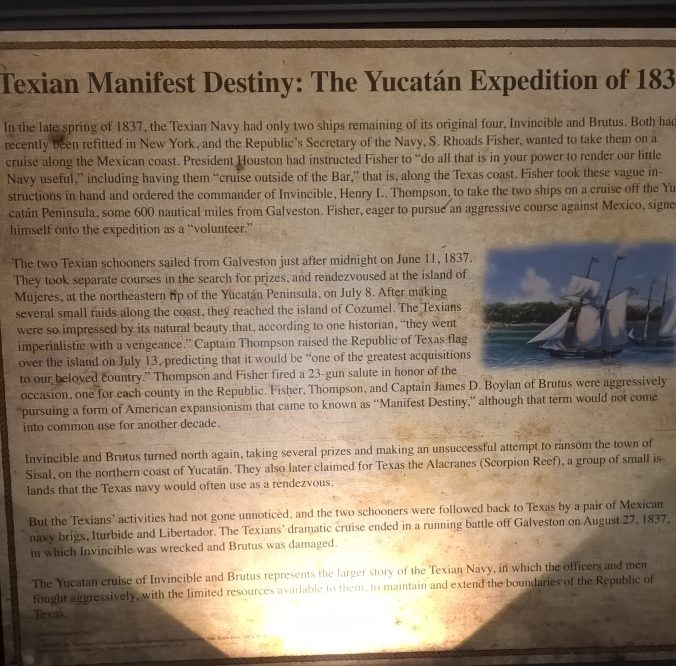
Photos of these two story boards did not come out very well – Husband could have done better had he been along – but they do give information on the importance of the Texas Navy early on and later as it continued to protect the new republic.

BATTLE OF CAMPECHE 1843
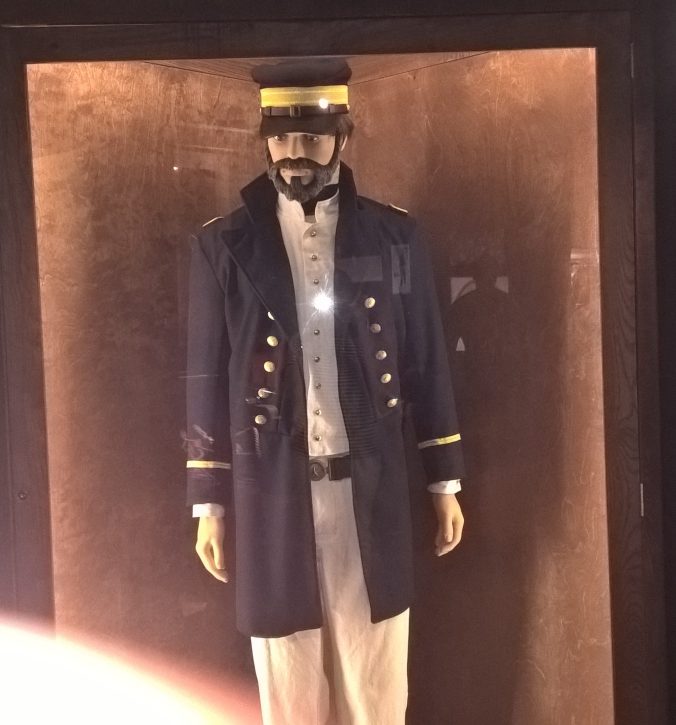
NAVAL OFFICER

I don’t know what the white object is on the left.  Perhaps it was one of the rumored ghosts on the Lexington.  It was a weekday afternoon and not very crowded, so I often found myself alone to leisurely view the Texas exhibit and  WWII photos and documents also as I competed the Lower Decks Tour.  OK, it was probably  my finger that got in the way!

SHIP’S WHEEL

Take a turn at the ship’s wheel!

CANNONS AIMED AT MEXICAN SHIPS

Visitors can get the feel of being on a ship in the heat of battle with this replica of a warship; note the Mexican flag on the ship being fired upon.

NAVAL GEAR AND ARTIFACTS

There were several displays like this one.
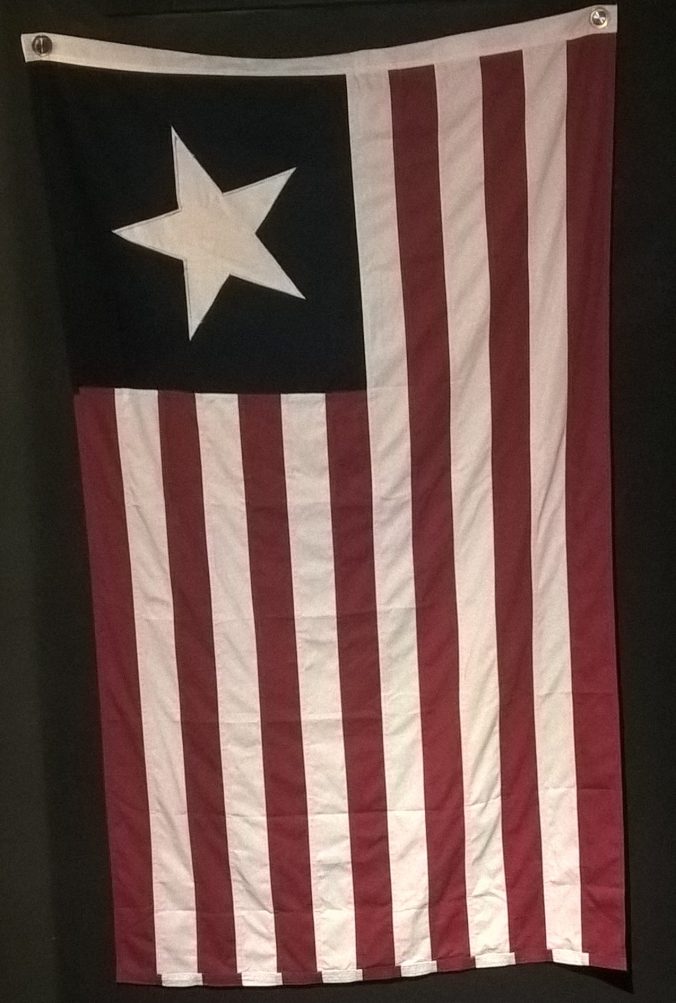
TEXAS NAVY FLAG

This is the Texas Naval flag.  Texas Flag Park describes it this way:

Created by Charles Hawkins for the Texas Navy in April, 1836 the Lone Star and Stripes Flag was adopted and continued unchanged for the life of the Republic. It carried a single white star in the blue canton, and seven red stripes and six white stripes alternating in color. The stripes represented the original thirteen colonies of the U.S. The flag was deliberately designed to resemble the national flag of the U.S. When the flag hung limp, it could be mistaken for the American flag which gave the underdog Texan fleet the advantage of surprise, and it worked.

There is a small theater inside the exhibit, though I did not take a photo, with an excellent documentary,  How the Texas Navy Saved the Revolution, a Kahunas USA / Texas Navy Association historic documentary.  The film is available to all Texas teachers for free download at texasnavy.org under the “Teachers” button.

When Texas joined the Union the proud Texas Navy was absorbed into the United States Navy.  “Texas Navy 1836-1846” is an excellent addition to the WWII exhibits on the Lexington for anyone who is interested in Texas history.


FRIDAY FOTO: Monterrey, Mexico, June 1991


1991 06 Monterrey Mexico 001

In June of 1991 Husband and I took a train from Nuevo Laredo, Mexico to Monterrey, Mexico.  The cars were not air-conditioned except for the club car where it was cool and the cervazas were cold.

1991 06 Monterrey Mexico 002

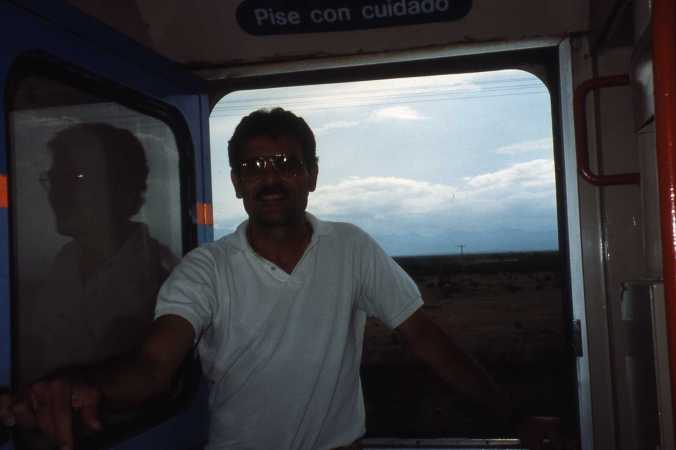
Husband reluctantly  posing for me between cars.

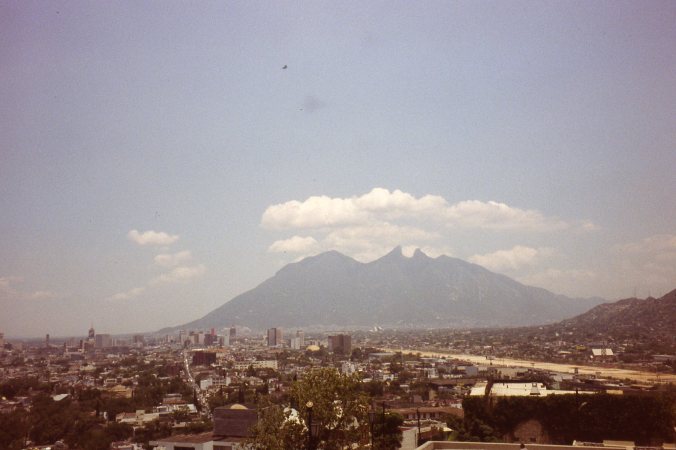
1991 06 Monterrey Mexico 023

View of Saddleback Mountain from the roof of our hotel.

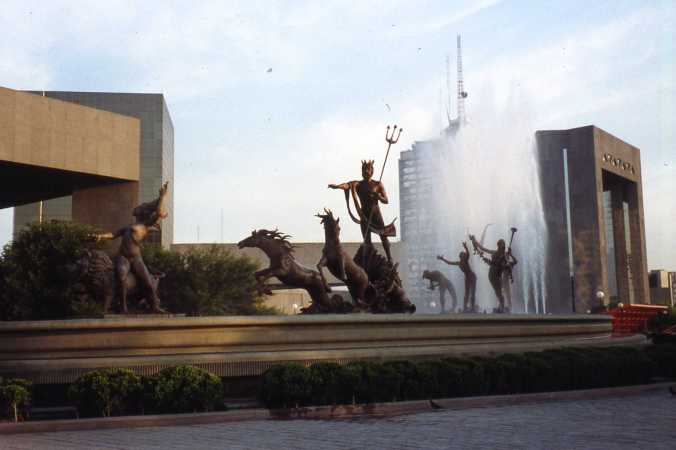
1991 06 Monterrey Mexico 007

Neptune Fountain at the Gran Plaza or Macroplaza

1991 06 Monterrey Mexico 014

Faro del Comercio (Lighthouse of Commerce), a column 230 feet high and 40 feet wide erected to commemorate 100 years of the founding of the Monterrey Chamber of Commerce.   At night it was lit by laser.

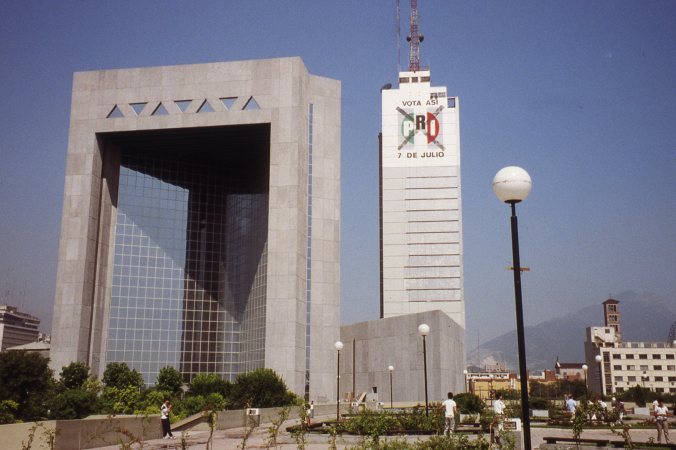
1991 06 Monterrey Mexico 009

Note the admonition on the building to “Vote like this – PRI – on July 7.”  The  Institutional Revolutionary Party (PRI) continued to hold political power in Mexico for seventy years until 2000 when Vicente Fox with PAN (National Action Party ) was elected President of Mexico.  Today the PRI has gained back some power with the election of President Enrique Pena Nieto.1991 06 Monterrey Mexico 016

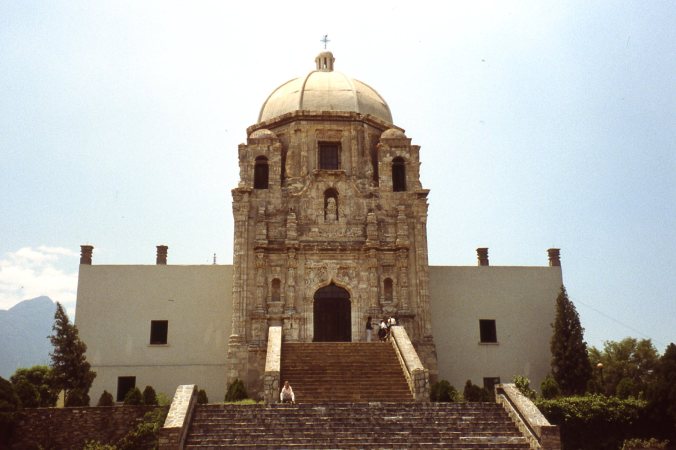
The Bishop’s Palace sits on a  hill in heart of the city.    Built in 1787-90 it was involved in the Mexican-American War as U.S. forces under General Zachary Taylor stormed up the steep hill  and overwhelmed the Mexican garrison at the top on September 22, 1846.  Now it is a museum – The Regional History Museum.  One can drive or walk up to it.  We walked and the view of the city was worth it.

1991 06 Monterrey Mexico 020

Courtyard inside the Bishop’s Palace

1991 06 Monterrey Mexico 022

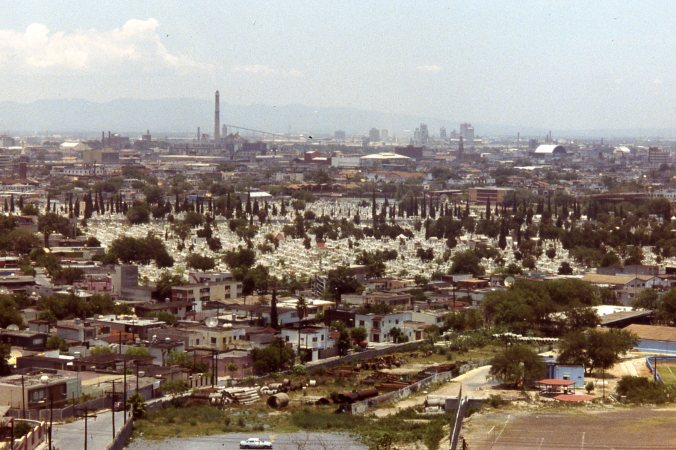
The white in the distance is a cemetery.  Beyond that is the industrial part of Monterrey.

Death’s Garden: Crossed Fingers


Loren Rhoads just published on her blog a piece that I wrote, “Crossed Fingers,” about a cemetery in Texas. She has an outstanding blog and is an impressive author. Check out her blog & my piece here and also check out her other writings at lorenrhoads.com

Loren Rhoads's avatarCemetery Travel

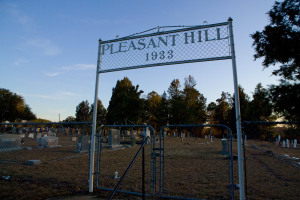
All photos of Pleasant Hill by Jo Nell Huff. All photos of Pleasant Hill by Jo Nell Huff.

by Jo Nell Huff

“Cemetery! Cross your fingers!”

The admonition floats to the surface of my consciousness like the command of an angel as I see the cemetery ahead on the left. The child within me obediently crosses the middle finger over the index finger of both hands. I continue to drive my car along the freeway at 70 miles per hour.

When I traveled with my family as a child, the females in the car crossed their fingers while passing a cemetery. Father did not participate. Either an older sister or my mother would warn of an approaching cemetery and we would all cross our fingers. I confess that I still do it after these years, even though I know it is foolish. While driving alone, I can boldly cross them without fear of derision. When traveling with fellow passengers…

View original post 1,737 more words