JAPANESE GOOD LUCK FLAG CEREMONIAL REUNION IN TOKYO


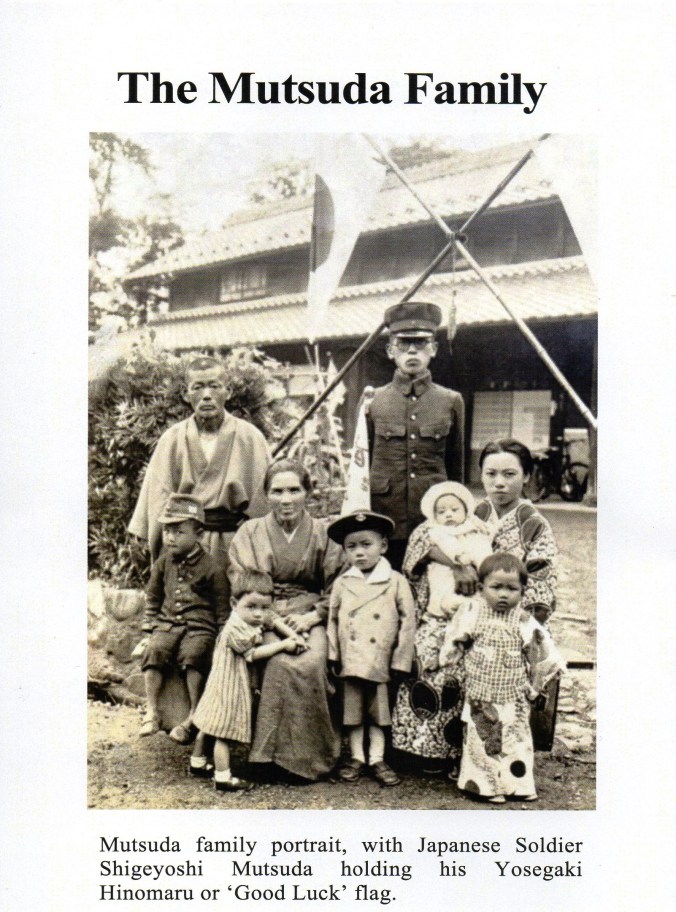
     Representatives from the USS Lexington Museum were in Tokyo, Japan recently, to reconnect a family after 80 years of separation, with the return of the Yosegaki Hinomaru or “Good Luck Flag”, that belonged to World War II Japanese soldier Shigeyoshi Mutsuda .  The ceremony took  place at a national shrine in Tokyo July 29th.  The children of Mr.Mutsuda received the flag, viewed as his spirit returning home, that can reunite with his wife who recently passed away at the age of 102.

Steve Banta, Executive Directer of the USS Lexington Museum (left); Toshihiro Mutsuda (right) son of Shigeyoshi Mutsuda (Photo Shuji Kajiyama/AP)

     The flag being returned was donated to the USS Lexington Museum in 1994.   It was only recently identified as a “Good Luck” flag; signed by family and friends of Japanese service members prior to leaving home for war. For Japanese families, the Good Luck Flags are often all that remains of their loved ones killed in action, and the return of the flag is seen as the return of their family member’s remains.

“Like many women of her time, Mrs. Mutsuda’s husband made the ultimate sacrifice for his country, which left her to provide for all of their family’s needs. The feeling of loss of her soulmate was very difficult, and only eased on rare occasions when she could make the long journey to the national shrine to commune with her husband’s spirit.
This shrine is where the ceremonial reuniting took place, with husband and wife finally finding peace, together.” (From USS Lexington Museum site)
Here is a link to my post about the Reparation Ceremony held July 20, 2023 on the USS Lexington Museum in Corpus Christi, Texas:  https://coastalcrone.com/2023/08/09/japanese-good-luck-flag-reparation/


JAPANESE GOOD LUCK FLAG REPARATION


THE JAPANESE GOOD LUCK FLAG

A special ceremony was held July 20,2023 at the USS Lexington Museum; below is a portion of the program.

“A flag donated to the USS Lexington Museum in 1994 was recently identified as belonging to a Japanese soldier named Shigeyoshi Mutsuda, killed in action during World War II.  Known as Yosegakki Hinomaru, or Good Luck Flags, these types of flags were signed by family and friends of Japanese service members prior to leaving home for war.  For Japanese families, the Good Luck Flags are often all that remains of their loved ones killed in action, and the return of the flag is seen as the return of their family member’s remains.

USS Lexington Museum is working in partnership with the OBON SOCIETY to repatriate the flag back to Japan for the flag to be reunited with the soldier’s surviving family members.  OBON SOCIETY is a non-profit organization that over the past 13 years has repatriated more than 500 flags back to Japanese families and communities.  The organization’s founders, Rex and Keiko Ziak, will act as representatives of the family to accept the flag and bring their long-lost patriarch home, including a ceremonial reuniting with his wife who recently passed at the age of 102.  Representatives from the USS Lexington Museum will accompany OBON SOCIETY to escort the flag on its journey back to Japan and the family.”

MELANIE TEMPLIN, left, Historian/Registrar; RACHELLE BANDA, right, Special Events Coordinator

As part of the ceremony, the flag (encased in a frame) was taken down from its place in an exhibit and presented to the representatives of the Japanese family.  Our daughter, on the left, is the Historian/Registrar for the USS Lexington Museum; the woman on the right is also an employee.  Those in the back in yellow shirts are volunteers for the museum; many are veterans.  The Japanese soldiers would have been able to fold the flag very small and keep it near their heart underneath their uniforms as they went into battle.

As the flag was removed from the exhibit and brought down for presentation,  a Japanese song about love and loss was played.  It became popular first in Japan and then hit the top of the charts in 1963 in the United States.  I remember it well

Below is a link to the ceremony held in the hanger bay of the museum.  It is about an hour long but is well done and symbolizes the friendship  and strong ties between the two countries today. The flag was returned to members of the Mutsuda family in Japan a week later.  I will have a post about that soon.  War brings loss and pain for the families on both sides.


The Shared Fate of the Robert E. Lee and the German U-166


German submarines posed a threat not only to ships crossing the Atlantic, but also to ships in the Gulf of Mexico. Between 1942 and 1943 approximately 70 ships in the Gulf of Mexico and off the coast of Texas were sunk by the German U-boats as they roamed the Gulf.

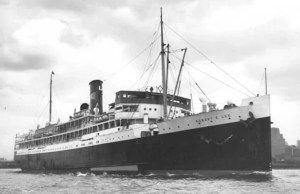
The passenger-freighter Robert E Lee had left Trinidad and was headed to Tampa when it was diverted to New Orleans. On board were passengers it had picked up from two other ships who were hit by torpedoes and was heading to New Orleans with an escort, USS PC-566.

The Robert E. Lee

On July 30, 1942 the Robert E Lee was hit by a torpedo fired by a German submarine or U-boat. The ship began to list and sank within fifteen minutes beneath the waters of the Gulf of Mexico about fifty miles from the mouth of the Mississippi River. Most of the of the passengers and crew were able to escape in life boats or with life jackets. One officer, 9 crewmen and 15 passengers of were lost. (total of 283 passengers were on board.)

The escort ship, USS PC-566 fired depth charges in the area where signs of it had last been seen. Soon after an oil slick appeared; it was assumed that the U-boat had been hit and destroyed. It and other boats in the area aided in the rescue of passengers and crew.

German U-166

In July of 2014, nearly 72 years later, stunning photos of the two wrecked vessels were released. The scientific ship, Exploration Vessel Nautilus had been checking for damage from the BP oil spill in 2010 when the scientists aboard came upon the wrecks only a two miles apart. Two remote operated submersible vehicles equipped with cameras captured clear images of both sites. Designated as war graves the casualties from World War II, they will not be disturbed.

Below is an excellent link put out by the scientific organization that took the photos. The images of the Robert E. Lee and U-166 are haunting.

A Tale of Two Wrecks: U-166 and SS Robert E. Lee

Thanks to blogger Brad Purinton for the inspiration for this post.  In a comment he left on my “Sand Pounders” post, he mentioned this incident. His father who was a child living in New Orleans at the time and remembered stories of German submarines near the mouth of the Mississippi His blog, Tokens of Companionship, features portrait photos from 1839 to 1939. Check it out here.

SAND POUNDERS


Sand pounders? What are they?  Tools for creating a sand sculpture? Some new social media? I had come across the phrase while doing some research for something I was writing that involved World War II.

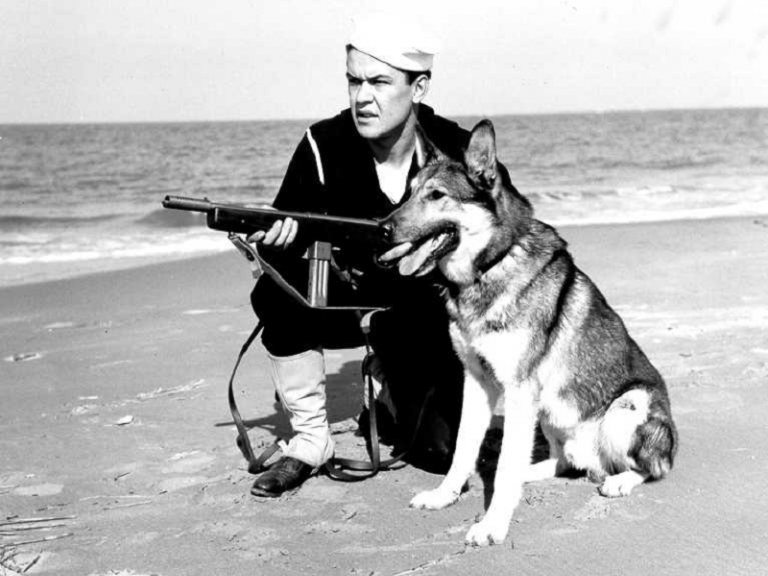
The Coast Guard Beach Patrol, eventually known as Sand Pounders, began in June 1942 in response to the threat of a German coastal invasion. The three main purposes were to “detect, observe and report offshore enemy vessels; to report enemy landing attempts; and to prevent people on land from communicating with the enemy at sea.” The threat of a coastal invasion by Germany was real to American citizens. German U-boats were a threat to ships crossing the Atlantic and were detected off the Eastern Coast and in the Gulf of Mexico. There was also the fear of invasion on the West Coast by the Japanese.

Coast guards would often be mounted on horses or on foot and were armed with radios and weapons. Those on horseback could cover ground more quickly and efficiently and usually work in pairs. Those on foot were often accompanied by dogs who could aid in detecting and protecting. German Shepherds, Doberman Pinschers and Airedales were used, with the German Shepherd the preferred breed.

At its height, the Beach Patrol consisted of around 24,000 men who protected 2,700 miles of coastline from potential enemy invasion; the patrols ended in 1944 when preparations for the Normandy invasion began. While the Coast Guard is not often given as much mention in World War II as perhaps the other military branches, the Beach Patrol played a vital part in protecting the United States coast from enemy attack.

THE OIL PATCH WARRIOR


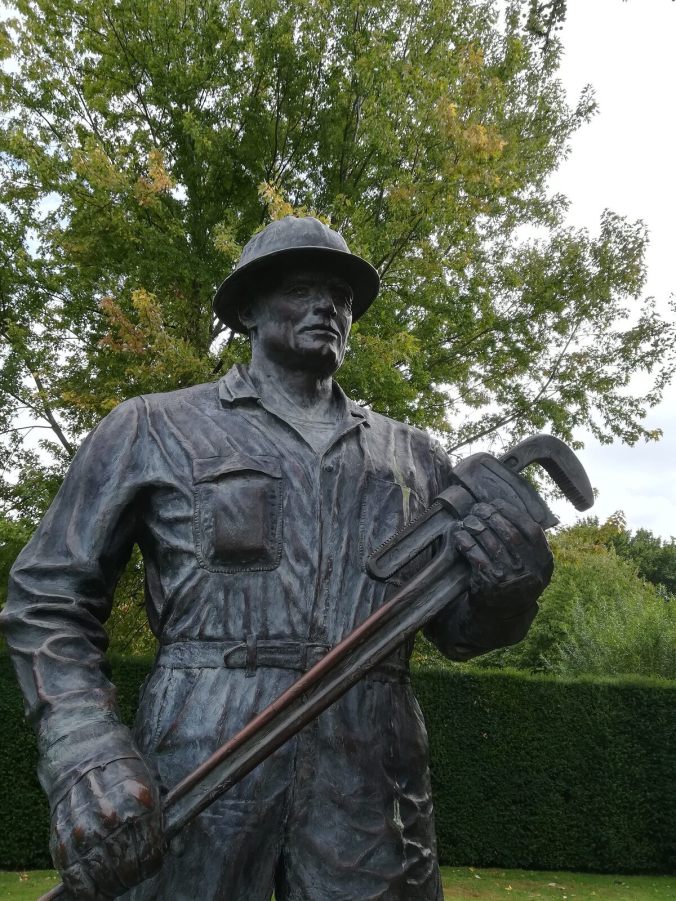
“The Oil Patch Warrior”

While researching for a writing project involving WWII draft classification codes, I discovered this bit of obscure history.

In March of 1943 a group of men departed New York on HMS Queen Elizabeth bound for London on a secret mission to do their part for WWII. They were 42 roughnecks from Oklahoma and Texas who volunteered for a one year contract to drill oil wells in Sherwood Forest for the British government.

Oil was essential for Brittan and its Allies. Production for oil was up in the United States, but Britain was falling behind and oil tankers from the United States and other countries were often sunk or blocked by German U-boats. The British government sent a representative of the oil industry to the United States seeking drilling rigs, pipes, drill bits and other related equipment that the British badly needed to replace some of their own.

In the negotiations two American companies, Nobles Drilling Corporation, headquartered in Ardmore, Oklahoma, and Fain-Porter Drilling Company, headquartered in Oklahoma City, partnered with D’Arcy Exploration Company, a British oil company. The US companies would provide the crews and drilling equipment to drill 100 wells in the heart of Britain’s only oil field deep in Sherwood Forest. The wells there were shallow, equipment was inadequate and many of the men doing the drilling were inexperienced as the war had taken many away.

The project was a secret mission with the men allowed to tell only their immediate families where they were going. London was already being bombed by the Germans and the oil field needed to continue to be kept secreted beneath the cover of the ancient forest safe from German planes. Rigs and equipment would be painted a green to blend in and camouflage them. The 42 roughnecks were housed at monastery run by monks.

By the end of the contract the 106 wells had been completed and oil production was up substantially. The men returned home in March of 1944 with the satisfaction of knowing they had made a contribution to the war efforts.

One man was left behind, Herman Douthit from Texas, a derrick hand who had died when he fell from a derrick. He was buried at the American Military Cemetery in Cambridge, one of the few civilians buried there.

The sculpture in the photo above is “The Oil Patch Warrior” and stands in Ardmore, Oklahoma as a tribute to the 42 men and erected in 2001. It is a replica of the original erected in 1991 near Nottingham England as a memorial to honor the 42 roughnecks and the oil industry. American sculptor Jay O’Melia designed the original.

A book, The Secrets of Sherwood Forest: Oil Production in England During World War II, by Guy H. Woodward and Grace Steele Woodward, is an excellent history of the events.

Below is less than 2 minute video with old photos.

http://https://www.youtube.com/watch?v=IYXqPOCTbEc