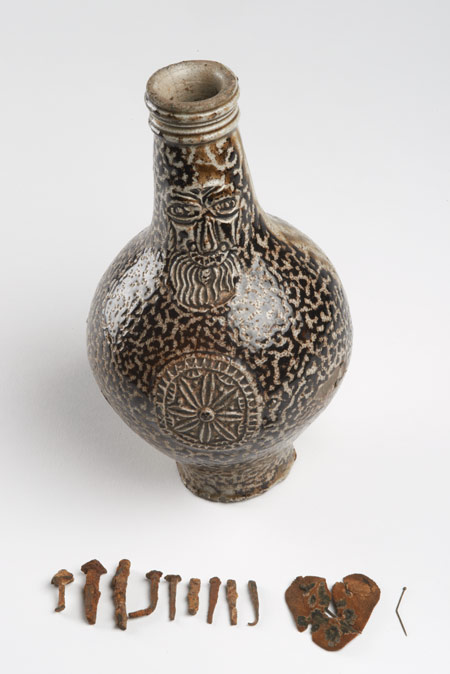
From the Museum of London: 17th century stoneware jug used a witch bottle found containing a heart-shaped piece of felt pierced with pins and 11 nails.
Witch bottles originated in the late-Middle Ages in England and were used as protection against witchcraft or to cure an illness. It was believed that a witch or evil spirit could be lured into a bottle and the spell could be broken. A bottle sealed with a cork would commonly contain the victim’s hair, nails, body fluids and even twine; some would contain red wine, rosemary, feathers and whatever talismans seemed to work at the time. Then they were buried or hidden, often under a fireplace or inside a wall; they could also be tossed into a stream or river. The one cursed would be safe as long as the witch bottle was hidden and unopened. Superstitions and belief in witches and evil spirits helped explain the world around them. Belief in the power of witch bottles was carried over to Colonial America; a small number have been found in the U.S.
The Museum of London’s website had an article titled “Sorcery on Display: Witch Bottles” that presented an authoritative history if one is interested in further reading.
Jace Tunnell, Director of Community Engagement for the Harte Research Institute at Texas A & M, Corpus Christi, has found eight modern day glass witch bottles on our local beaches. He has not opened them and keeps them on a fence in his back yard as he wife will not let him bring them into the house.
The HarteResearch Institute Facebook page describes them this way:
“Folks in certain cultures around the world put vegetation or other objects in a bottle, They are counter magical devices whose purpose is to draw in and trap harmful intentions directed at their owners.”
Tunnel speculates that they come from South America or the Caribbean.
If I find one on the beach, I don’t think I will open it or bring it into the house either.
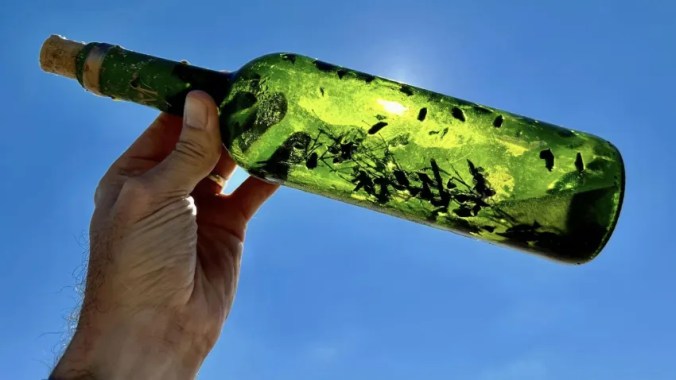
Witch bottle found by Jace Tunnell, Director of Community Engagement, Hart Research Institute at Texas A & M University, Corpus Christi



 THE COASTAL CRONE